
Robertson County Parole or Probation
Parole, mandatory supervision, and probation can all place rules on a person living outside a jail or prison, but they do not arise from the same event. Texas parole is a conditional release from state prison. The Texas Board of Pardons and Paroles makes the release decision, while the TDCJ Parole Division coordinates the release and supervises the person afterward. Mandatory supervision is another form of conditional state-prison release for eligible cases. Neither term describes an ordinary Robertson County bond release.
Probation is called community supervision in Texas. A court orders it, often instead of prison or with a local jail term. The Robertson County sentencing court and Adult Probation office own that record. Searching the parole board and finding nothing does not rule out probation. Likewise, a Robertson County probation order does not mean that TDCJ released the person from prison.
| Record | Who orders it | Who verifies it |
|---|---|---|
| Parole | Texas Board of Pardons and Paroles | TDCJ Parole Division and assigned office |
| Mandatory supervision | Texas law and applicable BPP review | TDCJ records and Parole Division |
| Probation / community supervision | Sentencing court | Robertson County Adult Probation and court clerk |
- Releasee
- A person outside prison while serving parole or mandatory supervision.
- Discharge
- Completion of the sentence and its supervision, not merely departure from custody.
- Absconder
- A person alleged to have stopped reporting or left supervision without authorization. Confirm the status with the responsible agency.
Verify Robertson County Post-Release Supervision
Begin with the conviction and custody system, not the present address. A Robertson County case may produce local probation, a transfer to state prison followed by parole, or no supervision at all. Use a TDCJ number, State Identification number, or court case number whenever possible. Names alone create errors, especially when a person has more than one booking or case.
- Check whether the person was sentenced to TDCJ or received community supervision from a Robertson County court. The judgment is the clearest starting record.
- For a current state prisoner, use the TDCJ Online Inmate Search. Match the TDCJ or SID number, date of birth, offense, county, and court.
- For parole or mandatory supervision, call the proper TDCJ status channel and locate the assigned parole office. A favorable vote or eligibility date is not physical release.
- For probation, contact Robertson County Adult Probation with the court and case number. Confirm the public status through the sentencing court when a formal order is needed.
- If online data conflict, ask the record owner directly. Historical state release or discharge data may require a TDCJ public-information request.
The live Robertson County jail roster answers a different question. It shows county custody, not the full post-release supervision record. A person who disappears from that roster could have been released, transferred to TDCJ, moved to another agency, or removed after a data change. The sheriff’s short released view can prove a departure time from county custody, but it does not label parole or probation.
Robertson County Supervision Offices
Robertson County has two distinct public office routes. The county’s Adult Probation office verifies court-ordered community supervision. TDCJ’s county cross-reference assigns Robertson County to the Bryan/College Station District Parole Office for state parole and mandatory-supervision work. An approved release location may differ from the conviction county, so the Bryan office is a routing point rather than proof of any person’s assignment.
109 W. Decherd Street
PO Box 1059
Franklin, TX 77856
Phone: 979-828-3226
Fax: 979-828-5051
1700 George Bush Drive East, Suite 150
College Station, TX 77840
Phone: 979-693-4977
Fax: 979-693-3374
Ask only for public status information. A supervision office may not disclose a person’s home, travel, treatment, or reporting schedule. Those limits protect sensitive information and do not imply that supervision is absent.
The official TDCJ Community Justice Assistance Division directory explains the local CSCD structure. Texas has judicial-district community supervision departments with partial state funding and oversight. They remain separate from the Board of Pardons and Paroles.
Robertson County Supervision Status Changes
Conditions are the rules attached to release or a court order. They can include reporting, payment, treatment, travel limits, or other case-specific duties. The actual certificate or court order controls. A public summary is not the full set of terms. If an alleged violation occurs, the supervising agency may investigate, seek a warrant, modify a condition, or begin a revocation process. The court or parole authority decides the legal result.
An absconder flag alleges that a supervised person has stopped reporting or cannot be located as required. It is not a new conviction. Verify any public flag with the Parole Division or Robertson County probation office and use matching identifiers. Do not infer absconder status from a missed appointment, stale address, or absent online result.
IVSS-Counties covers participating county custody and supervision events during Texas’s notification transition. TDCJ IVSS is the state-prison and parole or mandatory-supervision route. Alerts can lag and are not certified records, so match a change to the agency file.
Note: A notification is a prompt to verify with the responsible office, not proof that supervision began, ended, or was revoked.
Robertson County Parole Review
Texas does not hold formal named-inmate hearings for parole or mandatory-release consideration. BPP members review files and vote individually. The official parole review process says the Parole Division identifies a case before eligibility, an Institutional Parole Officer prepares a summary, and a three-person panel votes in sequence. Two matching votes make the decision.
A denial includes a later review point. An approval can carry conditions or require a program. Neither result is the same as an exit from prison. Release plans, prerequisites, certificates, and processing stand between a favorable vote and physical release. BPP’s status line is 844-512-0461. After favorable action, TDCJ Review and Release Processing can be reached at 512-406-5202.
The public board meeting archive concerns agency governance, not a calendar of Robertson County residents awaiting parole decisions. Person-specific review information must come from the inmate record and status contacts.
BPP vote codes also need exact treatment. Favorable codes may call for immediate or future action, or require completion of a named program before release. Denial codes can set a later review, require the sentence to continue, or direct service to a stated point. New facts can cause favorable action to be withdrawn. For that reason, translating every favorable code as “granted today” creates a false release date. Preserve the code, record the lookup date, and ask the status line or release-processing office what remains unfinished.
The official parole review page shows the case-preparation and panel sequence used by BPP.
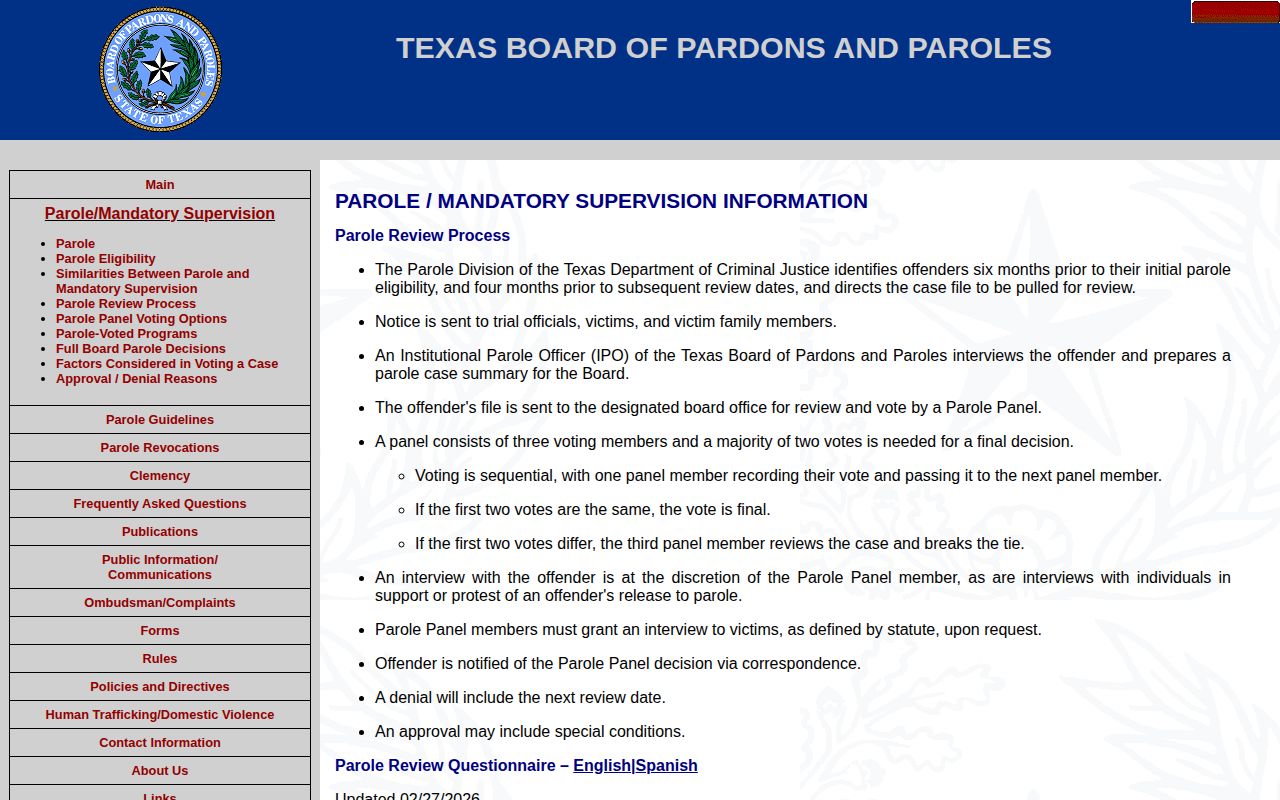
The sequence helps distinguish a review milestone from an approved and completed prison release.
Two Robertson County Verification Paths
Robertson County probation is not a BPP function. A person can complete a county jail stay and report to Adult Probation under a court order without ever appearing in the TDCJ parole process. Another person can leave TDCJ on parole and report to a district parole office even though the original conviction came from Robertson County.
For probation, preserve the case number, identify the sentencing court, call Adult Probation, and request the public court order from the clerk. For parole, preserve the TDCJ or SID number, check current state information, obtain the official vote or release-processing status, and confirm the assigned office. These paths meet only when one person has separate cases or overlapping duties.
The TDCJ CSCD directory provides a visual route to Robertson County’s community-supervision assignment.
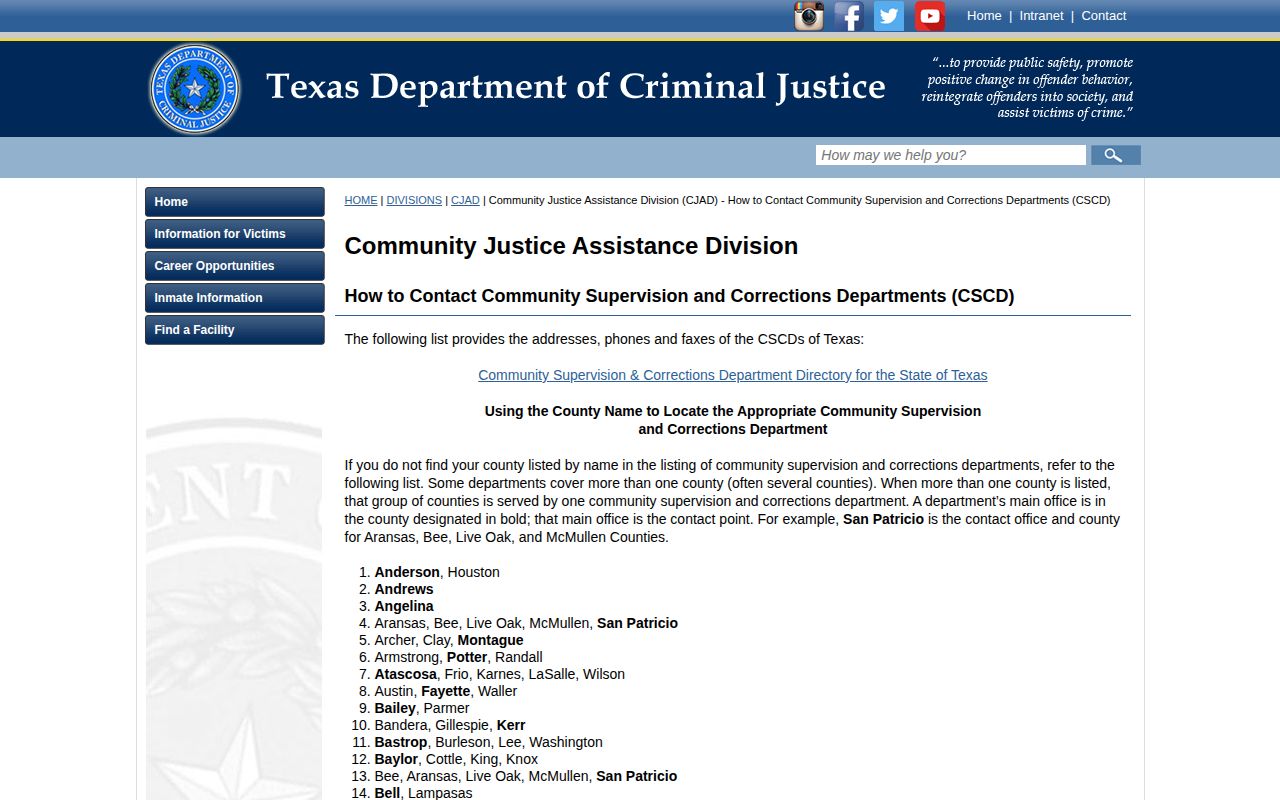
That directory supports the probation route, while TDCJ parole contacts remain the state-prison release route.
Robertson County Supervision Discharge
Supervision ends through an agency or court event, not because a public page no longer shows the person. For probation, use the order discharging community supervision, the docket, or a clerk response. Revocation, early termination, expiration, and successful completion are different outcomes and should retain their exact court labels.
For TDCJ, discharge means completion of incarceration and any parole or mandatory supervision tied to that sentence. A parole release date is not the discharge date. The current TDCJ inmate search includes only people then incarcerated in a TDCJ facility, so a missing profile cannot prove discharge. Request historical release or discharge records when the distinction matters.
Texas Government Code Chapter 552 governs public-record requests, subject to exceptions. A narrow request naming the person, TDCJ number or case number, date range, and exact discharge record is easier to process. The Robertson County released inmate search explains how jail and court records confirm the county custody event that may precede supervision.
When the court record matters, use the level that handled the case. The Robertson County Clerk handles county-level records, while the District Clerk maintains district matters. Ask for the judgment, probation order, revocation order, docket sheet, or discharge order by name. A jail timestamp cannot replace those documents, and a clerk docket cannot replace the physical custody record.
Public Record Search
Sponsored Results