
Robertson County Projected Versus Actual Release
TDCJ defines Projected Release Date as the date its Classification and Records Office calculates for an inmate to leave incarceration if parole does not occur sooner. It is a forecast for a current state prisoner. It differs from parole eligibility, maximum sentence expiration, discharge, and the actual moment a person exits. Offense type, offense date, sentence structure, credits, and Board of Pardons and Paroles action can all control the calculation.
A pretrial detainee at the Robertson County Sheriff’s Office Detention Center usually has no computed TDCJ date. Release may depend on bond, dismissal, a plea, trial, a court order, or transfer. Even a sentenced county-jail inmate does not use the TDCJ projected-date field. The sheriff and sentencing court calculate that local sentence under the judgment and applicable law.
Find a Robertson County Release Date
Identify the custodian before searching. A Robertson County arrest can remain local, move to TDCJ after conviction, or move to another agency. Leaving the county roster may be a transfer rather than freedom. Use the court judgment, booking number, TDCJ number, SID, and date of birth to keep the records tied to the right person.
- For a current TDCJ prisoner, open the TDCJ Online Inmate Search. Search by TDCJ or SID number when possible, or use last name, first initial, and the available identity filters.
- Match the county and court of conviction, offense, sentence, and identifiers. The online source covers only people currently incarcerated in a TDCJ facility and is not a former-inmate archive.
- Read Projected Release Date separately from parole eligibility and maximum expiration. Each answers a different question.
- For a county sentence, call the Robertson County jail at 979-828-3299 and request the sentence-calculation or release sheet. Compare it with the court judgment and jail-credit notation.
- For a pretrial case, check the bond and court docket. Do not calculate a fixed date where no sentence exists.
- Near the event, recheck the responsible system and obtain the actual release record. The Robertson County release search gives the local records path.
TDCJ says its online data are updated on working days and are at least one day old. A newly received state prisoner or a recent change may not yet appear. General locator information is also available at 936-295-6371 or 800-535-0283. Exact date of birth is required by phone when the TDCJ or SID number is unknown.
Texas Credits and Robertson Release Dates
Texas Government Code Chapter 498, especially sections 498.002 through 498.004, governs TDCJ good-conduct classifications, earning, and forfeiture. Good-conduct time does not reduce the sentence imposed by the judge. It affects parole or mandatory-supervision calculations only when the governing offense and date rules allow it.
There is no universal Texas rule that every person serves 85 percent of a sentence. Some serious offenses require flat calendar time equal to one-half of the sentence or 30 years, whichever is less, before parole eligibility, without good time reducing that minimum. Other cases use different formulas. Government Code sections 508.145, 508.147, and 508.149 address parole eligibility, the mandatory-supervision mechanism, and excluded categories. The controlling version of the law depends on the offense and offense date.
For an eligible offense committed before September 1, 1996, TDCJ explains that flat time plus good time may reach the sentence for projected release if parole has not occurred. For an eligible offense on or after that date, BPP must also approve discretionary mandatory supervision. A denial can move the projected date to maximum expiration. Later approval can move it forward for release processing.
Note: Apply the current statute and the law in effect for the offense date rather than using a fixed percentage from an informal source.
Why Robertson Release Dates Change
A projected date is recalculated as the underlying facts change. The direction is not always later. A favorable release decision or restored credit can move processing forward, while a hold, denial, or sentence correction can move it back. The displayed date should always be recorded with an “as of” date.
| Factor | Possible effect | Best confirmation |
|---|---|---|
| Credit loss or restoration | Changes a permitted calculation | TDCJ Classification and Records |
| BPP vote | Approval, denial, later review, or program condition affects release processing | BPP status and official vote code |
| Detainer or hold | May cause transfer to another custodian instead of community release | Custody record and receiving agency |
| New court order | Can amend sentence or custody terms | Signed order and docket |
| Concurrent or consecutive sentence | Changes the combined calculation | Judgments and TDCJ record |
| Data correction | Fixes an identifier, offense, credit, or date | Updated agency response |
Parole eligibility is only the first date discretionary release may be considered. A favorable vote still may require an approved plan, program, certificate, or other processing. Call BPP at 844-512-0461 for vote status. After favorable action, TDCJ Review and Release Processing at 512-406-5202 addresses the release-processing stage.
TDCJ Robertson Release Date Fields
TDCJ provides several access channels. The current online search shows active prison records. The basic email service at pia@tdcj.texas.gov can supply a TDCJ number, location, offense, incarceration history, current incarceration facts, and projected release date at no charge. Give the full name and seven-digit TDCJ number. If that number is unknown, provide an exact birth date or approximate age and county of conviction.
The TDCJ email information page lists Projected Release Date among the available fields.
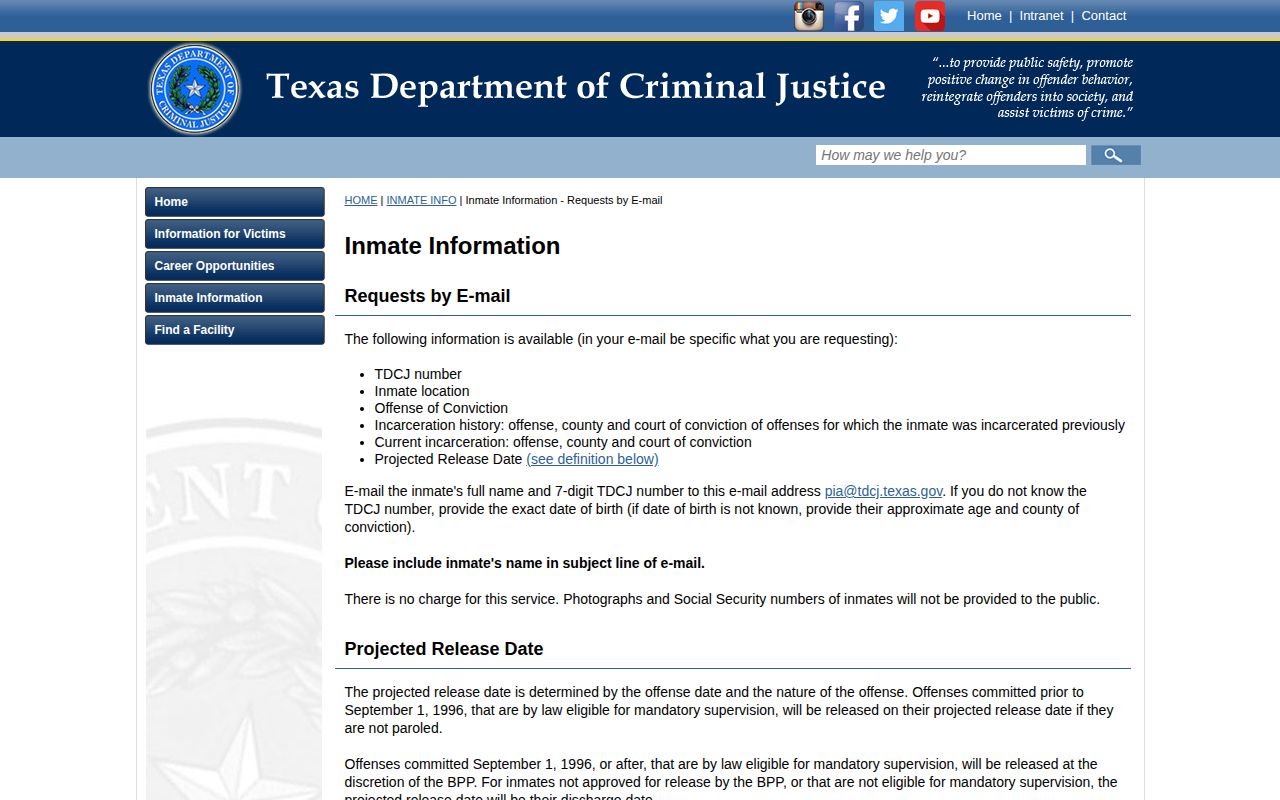
That field is useful for a current prisoner, but the same basic email channel does not provide photographs and should not be mistaken for a formal archival-record request.
A person released on parole, mandatory supervision, or discharge will not retain a durable public profile in the current-inmate search. For historical release data, request records through the TDCJ Office of General Counsel PIA channel. Ask for the actual release date, mechanism, maximum-expiration or discharge information, and incarceration history.
The formal channel accepts an online form, email to PIA@tdcj.texas.gov, mail to TDCJ Public Information Request, PO Box 4017, Huntsville, TX 77342, or hand delivery at 2 Financial Plaza, Suite 600, Huntsville. The basic inmate-information email and formal PIA process are not interchangeable. The first is suited to listed current-inmate facts. The second is the better fit for an existing historical release or discharge document.
Write the request around records that already exist. Include the full name, TDCJ or SID number, county of conviction, and a focused date range. Ask separately for actual release, discharge, incarceration history, and maximum-expiration data. That wording avoids treating one field as if it answered every date question. It also gives TDCJ enough detail to separate a Robertson County conviction from another same-name record.
Robertson County Release Calculation Limits
Robertson County publishes exact minute-level exit times in its rolling sheriff release view, but it publishes no local good-time, sentence-credit, or weekend-adjustment policy. A live entry may use a label such as “WEEKENDER,” which shows that intermittent confinement can occur. It does not establish a general formula for other people.
For a local sentence, request the individual calculation and compare three records: the judgment, any time-served or jail-credit entry, and the jail release sheet. Ask the Records Division to explain an agency code instead of trying to decode it from another county’s practice. No official local set release hour, holiday method, or weekend adjustment was found.
The sheriff’s 48-hour released filter proves the recorded exit time for a matched recent booking. It does not publish the legal calculation, disposition, or destination. A bond amount also does not prove why release occurred.
If the Robertson County record shows a release but a TDCJ record appears soon afterward, read the two events in order. The county ended its custody and transferred the person into the state system. That is not a community release. TDCJ’s projected date then becomes relevant only after the state record is created and matched. The county release timestamp remains evidence of movement from the Franklin jail, while the TDCJ record establishes continued incarceration.
Confirm Robertson County Release Timing
Use notifications prospectively. County custody events now route through IVSS-Counties during Texas’s transition from legacy VINELink. TDCJ state-prison custody and supervision notifications use TDCJ IVSS. The two systems must not be merged into one record. Neither is a federal locator.
Register against a matched record, keep the confirmation, and compare an alert with the source record. The Robertson County VINELink Release Check explains the current and legacy paths. Alerts can lag, and a missing person may simply fall outside a portal’s current coverage.
Close to the expected date, call the actual custodian. For Robertson County jail custody, use 979-828-3299 and ask whether the booking was released or transferred. For TDCJ, use inmate information and release processing. For a detainer, new case, or federal transfer, follow the documented receiving agency. The actual release sheet or TDCJ release record remains stronger than a forecast.
A detainer is a request or notice from another authority concerning custody. It can mean that reaching the end of one sentence leads to another agency taking control. The public result may still use a release date because one custodian closed its stay. Ask for the receiving agency and transfer notation when releasable. Do not describe the person as free until the next custody status is resolved.
Discharge is also narrower than casual use of “released.” TDCJ defines it as completion of the sentence and release from incarceration, parole, mandatory supervision, or community supervision tied to that sentence. A parole date begins supervised time outside prison. A discharge date ends the sentence’s custody and supervision. Keeping those labels intact is essential when reporting Robertson County release timing.
TDCJ’s definitions page shows why projected release and discharge must be read as separate events.
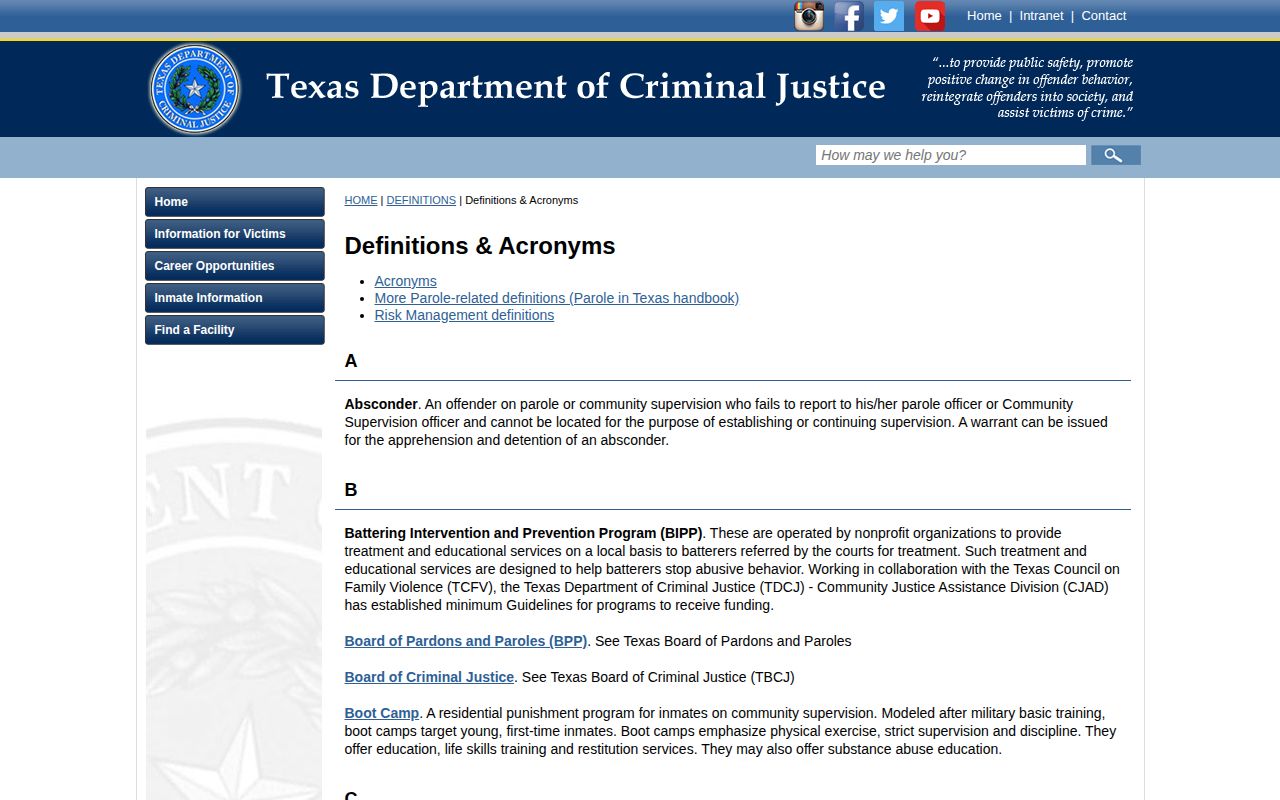
The official definitions prevent a projected date from being reported as a completed Robertson County release.
Public Record Search
Sponsored Results