
Federal Bureau Release Outcomes
The Federal Bureau of Prisons operates a nationwide prison system for people serving federal sentences. No BOP facility was verified inside Robertson County. Its role begins only when a federal case results in BOP designation and arrival. A Robertson County jail entry can end because another authority takes custody, but that local release does not establish that the person entered BOP or returned to the community.
A BOP release can lead to the community, federal supervised release, ICE action, or custody under another warrant. Supervised release is imposed by a federal court and follows incarceration; it is not continued imprisonment by BOP. The federal judgment and docket establish its terms. Another agency may take custody at the prison gate. For that reason, report the narrow event shown: released from BOP custody on the recorded date.
| Result | What it establishes | What remains unresolved |
|---|---|---|
| Named BOP facility | The locator associates the person with current BOP custody at that location | Projected movement and court status can still change |
| Released with date | BOP records departure from its custody | Supervised release or another custodian may remain |
| Not in BOP custody | BOP does not currently hold the person | USMS, ICE, state, county, or other status |
| No match | No result under the submitted terms | Identity error, coverage date, pretrial custody, or missing archival data |
Confirm a Federal Bureau Release
The BOP Inmate Locator covers federal incarceration from 1982 forward. A number search is safer than a name-only search. BOP accepts its register number and the listed DCDC, FBI, or INS identifiers. The name route uses first, middle, and last name with age, race, and sex filters. Match every returned identifier before relying on a date.
- Establish that the case is federal and that the person was sentenced or designated to BOP. A federal docket or prior BOP record is stronger than an assumption based on a county booking.
- Search the BOP register number when available. Otherwise enter the full name and narrow the result with the supplied personal fields.
- Compare register number, age, race, sex, location, and release date. Stop if identifiers conflict.
- Read “Released” or “Not in BOP Custody” only as a BOP status. Check the federal docket for a release order and supervised-release terms.
- If Robertson County records show a federal pickup but BOP shows nothing, determine whether USMS still handled the person before BOP designation.
- For older or missing BOP facts, request the existing record through the official federal records channel.
The locator result legend is easy to overread. “Released” can be accurate even when the person remains under court supervision. “Not in BOP Custody” can appear when another justice agency has control. Record the lookup date and preserve the register number. A BOP result should be paired with the judgment or docket when the legal terms matter.
The official BOP locator displays the fields and result labels used for a federal search.
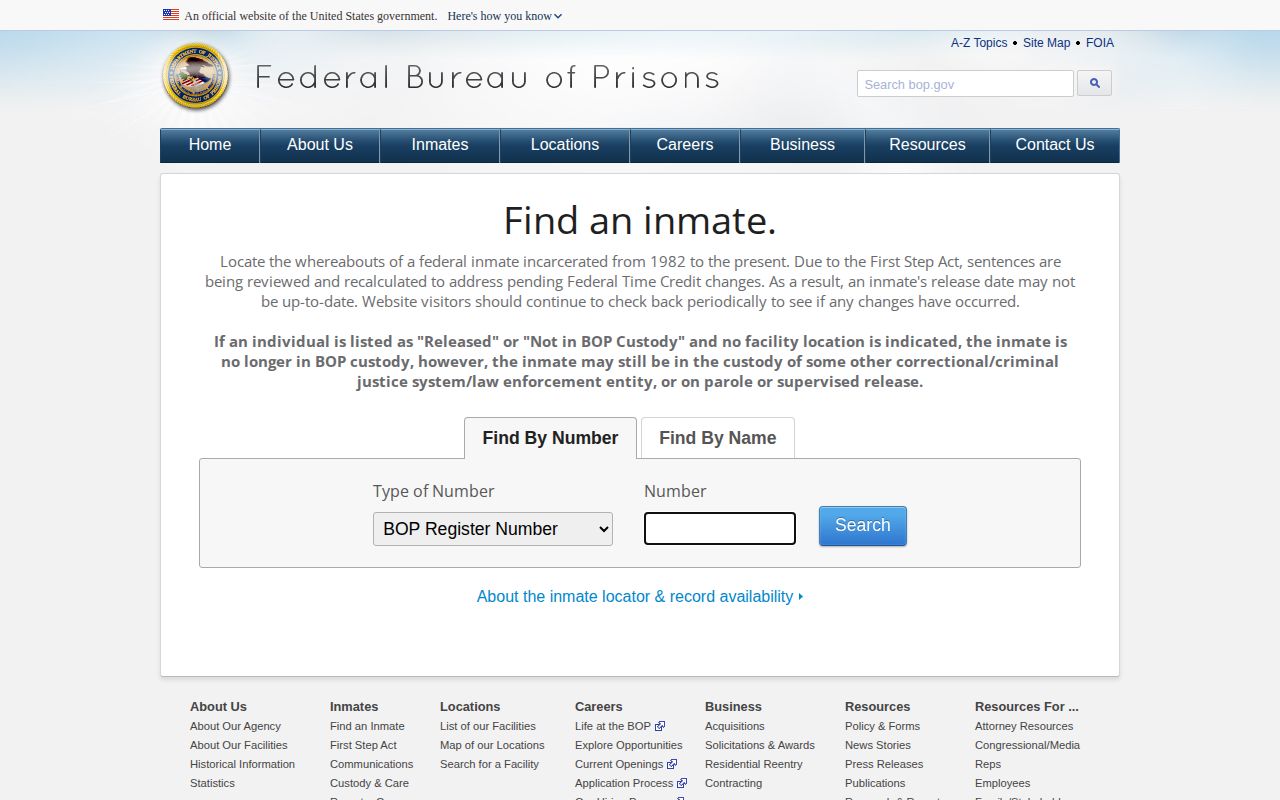
Those fields support identity matching, while the result label remains limited to BOP’s own custody.
Federal Bureau Records Contact
The public locator is the first route for a former sentenced federal prisoner. When it lacks older detail, the BOP Freedom of Information Act page is the archival fallback. Ask for existing records rather than a legal conclusion. Include the full name, register number and other known identifiers, facility if known, and a focused date range.
A useful request identifies the release or movement record sought, such as the recorded BOP release date, facility history, or transfer record. Privacy rules and exemptions can limit disclosure. Do not ask the Robertson County Sheriff to supply a BOP-created federal record. RCSO can supply its own release or transfer notation for the county booking, which can then be compared with the federal file.
FOIA is most useful after the public locator has been checked and its gap described. Save a copy of the search terms, the date, and any result. Then ask for a defined existing record rather than “all information.” A register number sharply improves routing. If the record belongs to a federal court or USMS rather than BOP, send the request to the agency that created it. One federal office does not automatically hold another office’s complete file.
The federal court docket is a separate source. It can show a commitment, sentence, release order, or supervised-release condition. A docket entry proves the court event, not the exact physical movement unless the filed document says so. Use both custody and court records when a complete sequence is needed.
USMS Is Not BOP Custody
The United States Marshals Service commonly houses and transports federal pretrial detainees. It can use federal, state, local, or private facilities. Once a federal district court orders detention, USMS may remain responsible until acquittal, court-ordered release, or BOP designation and arrival. That person may never appear as a current BOP prisoner during the pretrial period.
USMS does not publish a county-style recent-release roster. Confirm a pretrial federal release through the federal docket and release order, the holding facility, counsel or clerk when appropriate, and the relevant Marshals district. A wanted-person page is not a release locator. BOP should not be used to fill this gap because its mission and record coverage differ.
If the Robertson County Sheriff’s Office records a transfer to federal custody, ask which federal custodian received the person. The county’s rolling release view can show that Robertson County custody ended, but it does not label the destination or legal basis. A receiving-agency notation or federal docket is stronger evidence than disappearance from the county roster.
Robertson County Federal Transfers
A federal result should be pursued only when the case, court, jail, or agency supplies a factual federal connection. A Robertson County arrest does not imply a federal prosecution. Start with the local booking number and court case. If RCSO says the person was picked up on a federal hold, follow that documented transfer through the proper federal system.
The custody sequence can be written as Robertson County custody, then USMS responsibility, then BOP only after designation and arrival. Each transition needs its own source. A county release time followed by federal custody is movement between custodians, not a return to the community. The broader Robertson County release search explains how to obtain the local booking and release sheet.
Federal supervised release begins outside prison under a court order and is normally overseen through the federal probation system, not the Robertson County Adult Probation office or Texas parole board. Its existence should come from the judgment and docket. BOP’s release label alone does not describe its length or terms.
Federal Release Dates Can Change
A projected federal date can change after sentence computation, court action, or statutory credit recalculation. Research for Robertson County specifically notes that First Step Act recalculation can affect BOP projected dates. A projected date should therefore be labeled with the date it was checked and verified again near the event.
- Register number
- BOP’s identifying number for a federal prisoner and the best locator search key.
- Designation
- The placement process that assigns a sentenced person to BOP custody and a facility.
- Supervised release
- A court-ordered period in the community after incarceration, separate from BOP confinement.
- Release date
- The date BOP records departure from its custody, not proof that every other authority released the person.
When the locator and docket disagree, compare their dates and ask the record owner. A court may alter a sentence before the locator refreshes, or BOP may record a movement the public docket does not describe in detail. Neither source should be silently rewritten to match the other.
Release from BOP also does not end every court duty. The judgment may order supervised release after imprisonment, and a federal probation office may then supervise the person. That is distinct from Texas parole and Robertson County community supervision. Use the federal case number and signed judgment to confirm it. If another warrant or ICE action causes a new custody event, follow the new custodian rather than continuing to treat BOP as the active holder.
Note: Preserve the exact BOP label and lookup date; do not expand a federal custody result into a broader claim.
Public Record Search
Sponsored Results